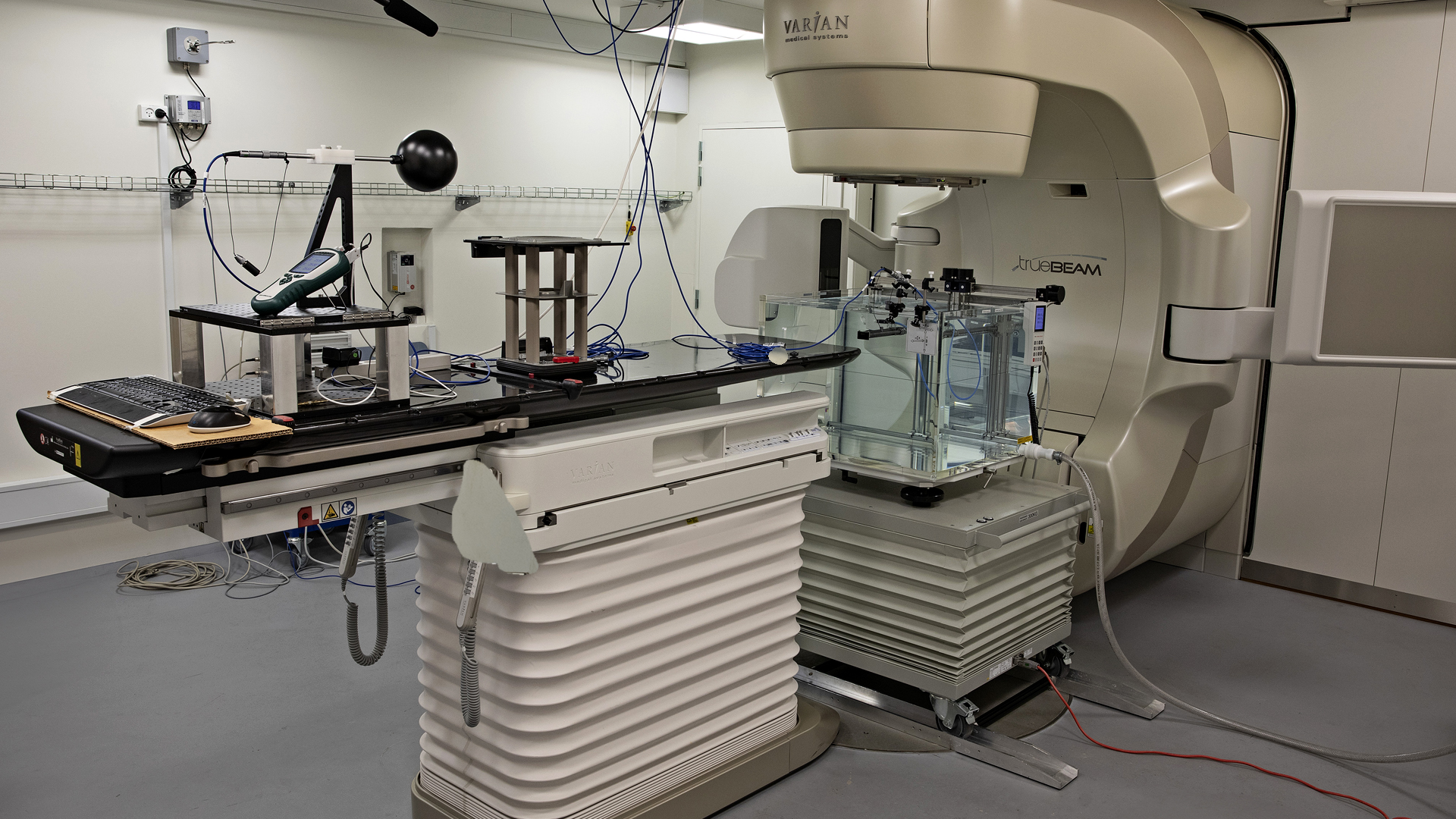
A Varian TrueBeam medical linear accelerator is operated at DTU Dosimetry for non-clinical use only. While similar accelerators are used in Danish hospitals for external beam radiotherapy, the TrueBeam at DTU is dedicated exclusively to dosimetry research, method development and calibration activities, and no patients are treated on this system.
The accelerator is used for irradiation of ionization chambers and other dosimeters in megavoltage (MV) photon and electron beams. Dosimeters are positioned using a dedicated calibration rig equipped with a motorized XYZ positioning stage with sub-micron resolution, enabling accurate and reproducible placement relative to the beam isocentre. Electrical and environmental parameters are monitored using dedicated instrumentation, including precision measurement of temperature for correction and verification purposes.
Calibration Geometry and Positioning
Prior to calibration, the accelerator isocentre is determined, and its position is transferred to the calibration rig using optical alignment methods. The reference distance from the isocentre to the water phantom is established using calibrated gauge blocks, ensuring traceable and reproducible geometry.
Calibrations are typically performed with the front surface of the water phantom positioned at a nominal distance of 100.0 mm from the isocentre. This distance is realized using a calibrated gauge block and a mechanical reference indicator mounted on the accelerator head. Where required, small geometric adjustments can be applied to achieve a density-equivalent depth of 10 g/cm².
For TPR20,10 measurements, a 200.0 mm reference distance is used. All linac calibrations are performed relative to an external monitor ionization chamber mounted in a dedicated fixture on the accelerator head, with continuous temperature monitoring of the monitor chamber to ensure measurement stability.
Ionization chambers can be positioned with high precision along the isocentre axis, with or without sleeves. Independent optical references are used throughout calibration sessions to verify the stability of the geometric alignment.